- جدید
- ناموجود


توجه : درج کد پستی و شماره تلفن همراه و ثابت جهت ارسال مرسوله الزامیست .
توجه:حداقل ارزش بسته سفارش شده بدون هزینه پستی می بایست 100000 ریال باشد .
توجه : جهت برخورداری از مزایای در نظر گرفته شده برای مشتریان لطفا ثبت نام نمائید.
 |
This article includes a list of references, but its sources remain unclear because it has insufficient inline citations. Please help to improve this article by introducing more precise citations. (January 2013) |
| Friedrich Wolf | |
|---|---|

Friedrich Wolf (1952)
|
|
| Born | 23 December 1888 Neuwied, Rhine Province, Germany |
| Died | 5 October 1953 Lehnitz (Berlin), Brandenburg, Germany |
| Occupation | Physician writer politician Diplomat |
| Political party | KPD (1926) SED (1950) |
| Spouse(s) | Kaethe Gumpold (1914) Else (Eva) Dreibholz (1922) |
| Children | Johanna Marie (1915) Lukas (1919) Markus 1923–2003 Konrad 1925–1982) by Irmgard Schaaf Thomas Naumann (1953) |
| Parent(s) | Max & Ida Wolf |
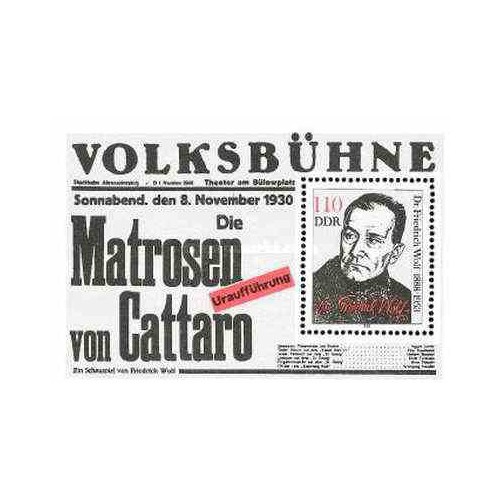
Friedrich Wolf (23 December 1888 – 5 October 1953) was a German doctor and a politically engaged writer. From 1949 to 1951, he served as East Germany's first ambassador to Poland.[1]
Wolf was born in Neuwied (Rhine Province), the son of a Jewish merchant.
From 1907 until 1912 he studied medicine, philosophy and art history in Munich, Tübingen, Bonn, and Berlin and became a doctor in 1913. In 1914 he worked first as a ship's doctor on the route between Canada, Greenland and the United States, and then in the same year became a field doctor on the Western Front in World War I; this experience made him a strong opponent of war. In 1917 he published his first prose pieces.
_1988,_MiNr_Block_096.jpg)
In 1918 he became a member of the Workers council in Dresden and joined the Independent Social Democratic Party of Germany. After the war he worked as a doctor in Remscheid and Hechingen, where he focused on care for common people and prescribed treatment using naturopathic medicine. In 1923 and 1925 his sons Markus and Konrad were born. After 1928 he became a member of the Communist Party and the Association of Proletarian-Revolutionary Authors. In 1929 his drama "Cyankali" sparked a debate about abortion, and he was briefly arrested and charged for performing abortions.
In early 1932 he founded the Spieltrupp Südwest in Stuttgart, a communist agitprop group of lay actors that created controversial pieces about current topics.
After the Nazis came to power, Wolf emigrated with his family to Moscow. In 1938 he made his way to Spain to work as a doctor in the International Brigades. However, he was arrested in France and interned in the concentration camp Le Vernet. In 1941 he gained Soviet citizenship and returned to Moscow where he became a founder of the National Committee for a Free Germany (NKFD).
In 1945 he returned to Germany and was active in literary and cultural-political issues. From 1949 to 1951 he was the first ambassador of East Germany to Poland. On 5 October 1953 he died in his personal office in Lehnitz.
تشکر نظر شما نمی تواند ارسال شود
گزارش کردن نظر
گزارش ارسال شد
گزارش شما نمی تواند ارسال شود
بررسی خود را بنویسید
نظر ارسال شد
نظر شما نمی تواند ارسال شود
check_circle
check_circle